 Gooby
Gooby
Atlas: the four-colour map puzzle
Paint every region of the map with one of four colours — and never let two neighbours match. 2,000 verified maps (map coloring puzzles, if you spell it that way), from small and friendly to big and devious, with no ads and no sign-up.

How to play Atlas
The board is a map of irregular regions. A few of them start coloured (they carry a small dot). Colour the rest so that:
- Every region gets one of four colours: yellow, blue, red or purple.
- Two regions that share a border never have the same colour.
That's all. The four colour theorem promises any map can be coloured this way; the starting colours pin down exactly one answer, and you find it by logic alone — no guessing.
Controls
- Pick a colour from the four swatches, then tap a region to paint it. Tap it again with the same colour to clear it.
- Turn on Notes to jot down the colours a region could still be — small dots, like pencil marks. Colouring a region removes that colour from its neighbours' notes.
- Two neighbours with the same colour get a red border between them, so clashes are easy to spot.
- Prefer shapes to colours? Turn on colour symbols (● ▲ ■ ◆) in the game settings.
Atlas strategy: four techniques
Think in terms of what each region can still be. Every colour you place takes that colour away from all its neighbours. These are the techniques our hints use, from easiest to hardest, each on a real position from the game.
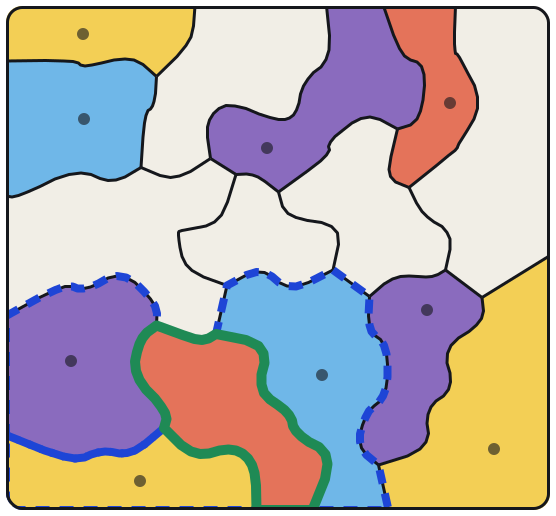
1. Last Colour
Look at a region's neighbours. If they already use three different colours, the fourth is the only one left — paint it. On easy maps this is all you need: each new colour sets up the next Last Colour.
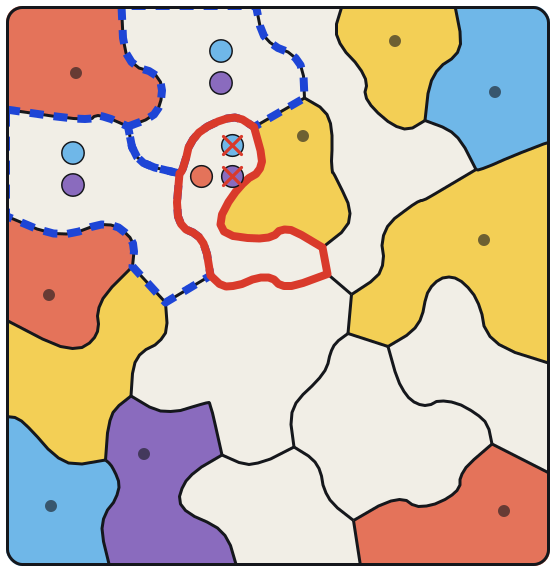
2. Colour Pair
Two regions that touch each other and can both only be the same two colours — say blue and purple — will use one each. So any region touching both of them can be neither blue nor purple.
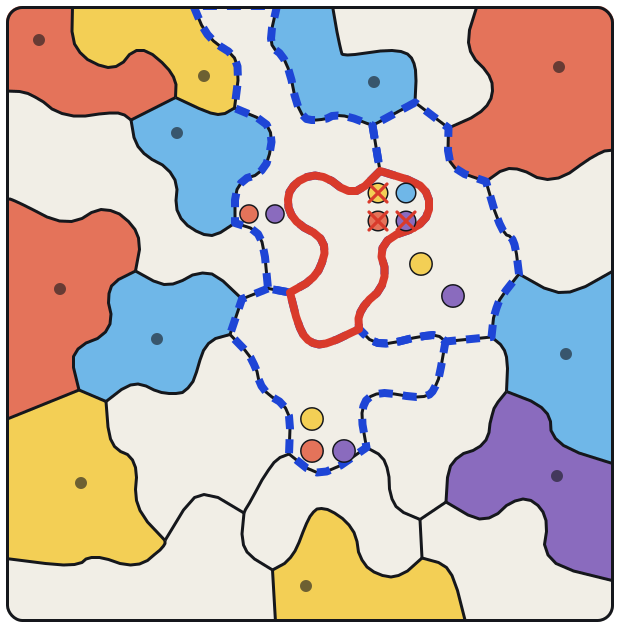
3. Colour Triangle
The same idea with three: three regions that all touch each other and share only three colours between them use all three. A region touching all of them must take the fourth.
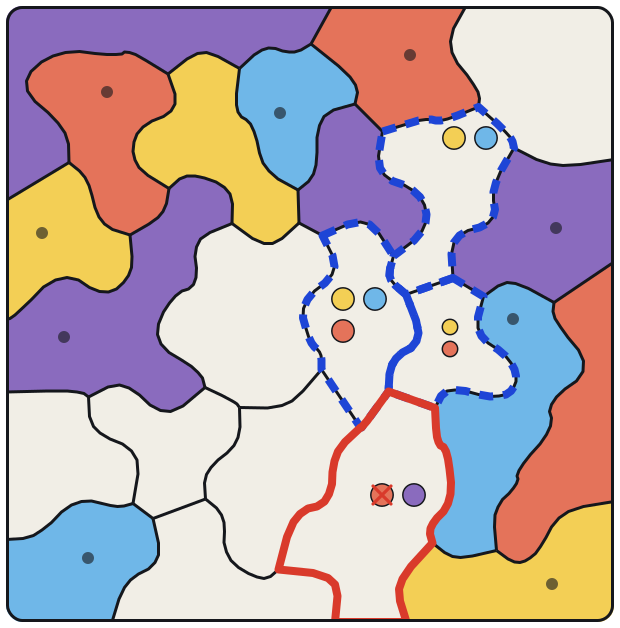
4. Dead End
Try a colour in your head. If it forces a neighbour to its Last Colour, and that one forces another, and soon some region has no colour left at all, the colour you tried was wrong — rule it out. Short dead ends are easy to see once you look for regions with only two options.
Difficulty that adapts to you
There are no levels to unlock. Every finished puzzle updates your rating — clean, hint-free wins count most and a lost game lowers it — and the next map is chosen around your rating, with the odd easier breather and harder stretch.
| Tier | Regions | What it takes |
|---|---|---|
| Easy | 15 – 18 | Last Colour only |
| Medium | 18 – 22 | A Colour Pair, or a long Last Colour chain |
| Hard | 20 – 25 | Several Colour Pairs and Triangles |
| Expert | 23 – 28 | One Dead End |
| Master | 26 – 32 | Two or three Dead Ends |
| Extreme | 30 – 36 | Four or more Dead Ends |
Tiers are graded by the logic each map needs: the solver works through it the way a person would and counts which techniques it had to use.
Atlas questions
Why four colours?
The four colour theorem says any flat map can be coloured with four colours so that no two neighbouring regions match. Atlas turns that into a puzzle: some regions start coloured, and you work out the only colouring that fits.
Do regions that only touch at a corner count as neighbours?
There are no corner-only touches in Atlas. Every pair of regions either shares a clearly visible border, which means they must differ, or doesn't touch at all.
Do I need to guess?
No. Every puzzle has exactly one solution and is checked to be solvable by logic alone, using the techniques on this page.
Can I play Atlas offline?
Yes. After the first visit all puzzles are stored on your device, so it works with no connection. Add it to your home screen to use it like an app — here's how.
How does the difficulty work?
Atlas adapts to you. Each finished puzzle updates a skill rating, and the next puzzle is picked around it, from Easy maps of 15 regions up to Extreme maps of 36.