 Gooby
Gooby
Meowdoku: the Queens-style puzzle with cats
Place one cat in every row, every column and every colour — and keep the cats apart. 2,000 puzzles from 6×6 to 10×10, as many as you like, with no ads and no sign-up.

How to play Meowdoku
The board is a square grid split into coloured areas — as many colours as there are rows. Place the cats so that:
- Every row has exactly one cat.
- Every column has exactly one cat.
- Every colour has exactly one cat.
- No two cats touch — not side by side, and not diagonally.
If you've played Queens or Star Battle (one star), you already know the rules — Meowdoku just swaps crowns and stars for cats. Every puzzle has exactly one solution and can be solved by logic alone, no guessing.
Controls
- Tap a cell to mark it with ✕ — "no cat here". Tap again to clear it.
- Double-tap to place a cat. Double-tap a cat to remove it.
- Drag across cells to mark many ✕ at once; drag starting on an ✕ to erase.
- Turn on auto ✕ in the game settings to cross out every cell a new cat rules out.
Meowdoku strategy: four techniques
Solving is mostly crossing out. Every ✕ you place narrows the options until a cat has only one spot left. These are the four techniques our hints use, from easiest to hardest, each on a real position from the game.
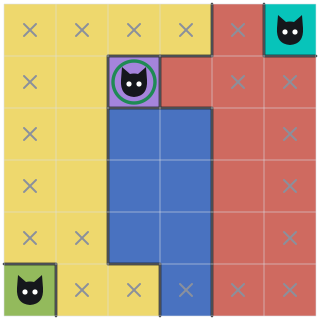
1. Last Spot
When a row, column or colour has only one cell left that isn't crossed out, its cat goes there. Then cross out everything that cat rules out: its row, its column, its colour and the eight cells around it.
2. Colour Lock
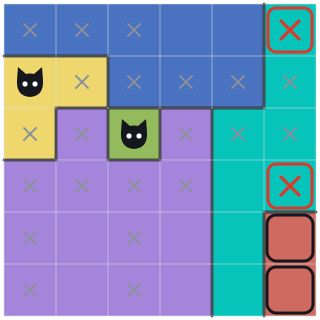
If every open cell of a colour lies in one row (or one column), that colour's cat will be in that row. So no other colour can use the row — cross out the rest of it. It also works the other way: if a row's open cells all belong to one colour, that colour's cat is in this row, so cross out the colour's cells elsewhere.
3. Confinement
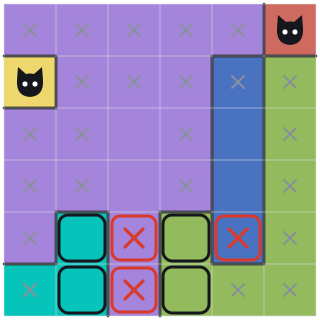
Colour Lock with more colours. If two colours fit only inside the same two rows, those two rows are taken by those two colours, so every other colour's cells in those rows can be crossed out. The same goes for three colours in three rows, and for columns.
4. Blocking Cat
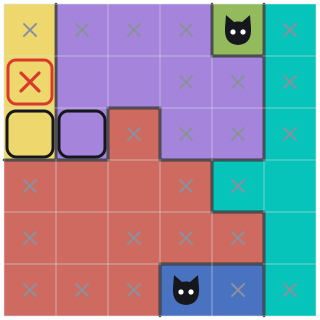
Imagine a cat on a cell. If it would cross out every remaining spot of some row, column or colour, that cell can't hold a cat — mark it ✕. It's most useful next to small colours and short rows, where a single cat and its eight neighbours cover a lot.
Difficulty that adapts to you
There are no levels to unlock. Every finished puzzle updates your rating — clean, hint-free wins count most and a lost game lowers it — and the next puzzle is chosen around your rating, with the odd easier breather and harder stretch.
| Tier | Boards | What it takes |
|---|---|---|
| Easy | 6×6 – 8×8 | Last Spot and Colour Lock |
| Medium | 6×6 – 9×9 | Longer chains, some Confinement |
| Hard | 7×7 – 10×10 | Confinement and Blocking Cats |
| Expert | 7×7 – 10×10 | Long chains of Blocking Cats |
| Master | 8×8 – 10×10 | Few obvious moves; patience required |
| Extreme | 9×9 – 10×10 | Beyond the four techniques |
Tiers are graded by the logic each puzzle needs, not by board size — a tricky 7×7 can be harder than an open 10×10.
Meowdoku questions
Is Meowdoku like the Queens puzzle?
Yes. The rules are the same as Queens-style puzzles (also known as one-star Star Battle): one piece in every row, column and coloured region, and no two pieces touching, even diagonally. In Meowdoku the pieces are cats.
Is there a daily limit?
No. There are 2,000 puzzles and you can play as many as you like, whenever you like, for free.
Can I play Meowdoku offline?
Yes. After the first visit all puzzles are stored on your device, so it works with no connection. Add it to your home screen to use it like an app — here's how.
How does the difficulty work?
Meowdoku adapts to you. Each finished puzzle updates a skill rating, and the next puzzle is picked around it, from Easy 6×6 boards up to Extreme 10×10 boards.